
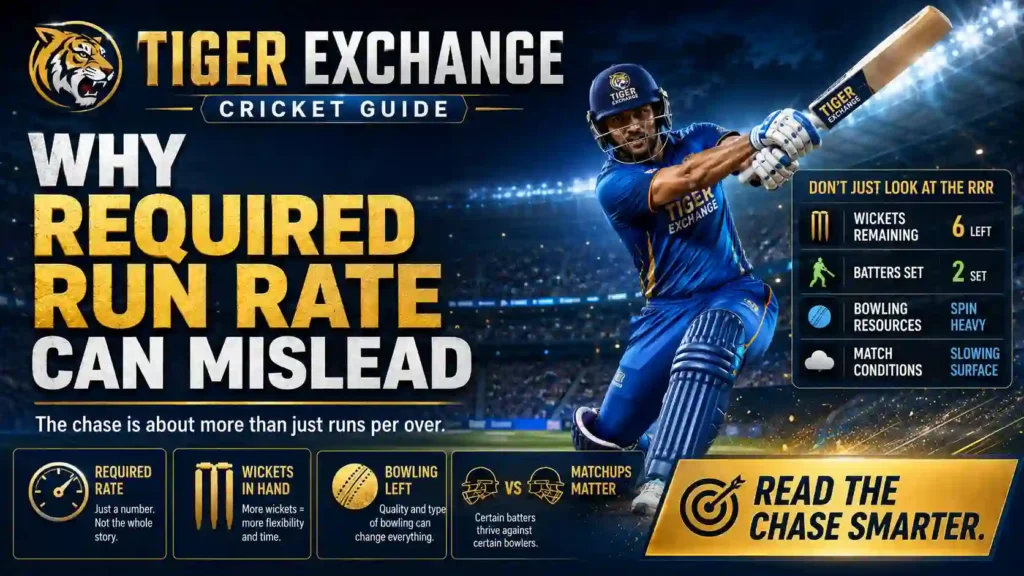
The required run rate is one of the first numbers fans look at during a cricket chase.
Team needs 60 from 30 balls.
Required rate: 12 per over.
Simple, right?
Not always.
Two teams can have exactly the same required rate and face completely different situations.
One might have eight wickets remaining and two established batters at the crease.
The other could be six wickets down with the opposition’s best death bowlers still waiting.
The number is identical.
The pressure is not.
For fans following live cricket through Tiger Exchange, learning to read the story behind the required rate can provide a much clearer picture of how a chase is actually developing.
What Is Required Run Rate?
Required run rate tells you how quickly a chasing team needs to score.
For example:
Team needs:
60 runs from 30 balls
Thirty balls equals five overs.
So:
60 ÷ 5 = 12 runs per over
This gives an immediate snapshot of the challenge.
But it is only one part of the match.
Why Wickets Remaining Matter
Compare these two situations.
Team A
60 required from 30 balls
Score: 140/2
Team B
60 required from 30 balls
Score: 140/7
Same target.
Same balls remaining.
Completely different chase.
Team A still has batting depth.
Team B has very little margin for error.
That is why wickets are often more important than a small change in required rate.
The Batter at the Crease Matters
Imagine 50 runs are required from 24 balls.
If two set power hitters are batting, the chase may feel possible.
If two new batters have just arrived, the same requirement can become much harder.
Established batters already understand:
Pitch pace
Boundary dimensions
Bowling rhythm
New batters need time.
T20 cricket rarely gives them much.
Bowling Resources Change the Equation
A required rate of 10 per over may look manageable.
But who is bowling?
If the fielding side still has overs left from its best death bowlers, the challenge is much greater.
If those bowlers have already finished, the batting side may see an opportunity.
When following a chase on Tiger Exchange, don’t look only at:
runs and balls.
Also check:
bowlers and overs remaining.
One Big Over Can Distort the Picture
Suppose a team needs:
72 from 36 balls
Required rate: 12.
Then one over produces 20 runs.
Suddenly:
52 from 30 balls
Required rate drops to 10.4.
The chase looks completely different.
This is why T20 momentum changes so quickly.
One over can reduce enormous pressure.
One quiet over can bring it straight back.
Dot Balls Increase Pressure Quietly
Boundaries get attention.
Dot balls often do more damage than fans realize.
A team needs:
40 from 24 balls
Then three consecutive dots.
Now it needs:
40 from 21 balls
Nothing changed in the runs column.
But the required rate has climbed sharply.
This pressure often forces a batter to attempt a riskier shot.
Boundary Percentage Matters
A team needing 12 per over does not necessarily need two sixes every over.
The runs can come from:
Singles
Twos
Fours
Occasional sixes
A partnership that rotates strike effectively can sometimes manage a difficult chase without constant big hitting.
This is why a batter who only searches for boundaries may actually make the situation harder.
Why Strike Rotation Is Important
Imagine one batter is struggling against spin.
If they remain on strike for most of the over, pressure builds.
A single can change the matchup.
Now the stronger player faces the bowler.
This is why singles can have tactical value beyond the one run added to the total.
The Final Overs Are Not Equal
Fans often assume:
“Three overs left means 18 balls.”
Mathematically, yes.
Tactically, no.
Those three overs may include:
The opposition’s best fast bowler
A weaker fifth bowler
A spinner struggling with dew
The order matters.
A team may deliberately target one particular over.
That strategy can completely change how a chase develops.
Why Tiger Exchange Users Should Watch Matchups
Suppose a batter has been dominating pace.
The captain brings on leg-spin.
The required run rate may still look comfortable.
But the matchup has changed.
Now ask:
Can the batter rotate strike?
Is the boundary longer on that side?
Is the bowler getting turn?
Numbers become more useful when combined with these tactical details.
Required Rate vs Current Run Rate
Another useful comparison is:
Current run rate vs required run rate
Suppose a team has scored at 8.5 per over but now needs 11.
It has to accelerate.
If the current rate is already 10.8 and the required rate is 10.5, the situation may be under better control.
However, even this comparison needs wickets and bowling resources for context.
Why a Chase Can Feel Easier Than the Numbers Suggest
Sometimes a required rate of 13 is not as frightening as it looks.
For example:
Seven wickets remain
Two power hitters are set
Short boundary on one side
Weak bowler has two overs left
Dew is helping batting
The context can make the chase more achievable than the number alone suggests.
Why a Low Required Rate Can Still Be Dangerous
The opposite can happen too.
A team needs:
30 from 30 balls
Only six per over.
Looks easy.
But perhaps:
Eight wickets have fallen
Tailenders are batting
Ball is turning sharply
Opposition’s best spinner has two overs left
Again, context changes everything.
Don’t Assume a Chase Is Finished After One Over
Fans often overreact.
One 18-run over:
“Game over.”
One wicket maiden:
“Impossible now.”
T20 cricket can change again almost immediately.
A calmer approach is to reassess after every over rather than every delivery.
A Simple Chase-Reading Framework
When following live cricket, look at six things.
1. Runs Required
What is the target?
2. Balls Remaining
How much time is left?
3. Wickets Remaining
How much risk can the batting side take?
4. Batters at the Crease
Are they set or new?
5. Bowlers Remaining
Who controls the final overs?
6. Conditions
Is the pitch, dew, or boundary size helping either side?
Together, these provide a much better picture than required run rate alone.
Why Live Markets Change So Quickly
Live sports markets react to new match information.
A wicket can alter expectations.
A boundary can do the same.
So can:
Injury
Rain
Bowling change
Required rate
Partnership growth
That is why the numbers users see through platforms such as Tiger Exchange may change repeatedly during a match.
Live sport is constantly updating.
Avoid Chasing Momentum
A team may look completely in control.
Then lose two wickets.
Another may appear out of the match before one huge over.
Momentum is useful for describing the present.
It does not guarantee the future.
That uncertainty is part of cricket.
Responsible Live Sports Engagement
Sports outcomes remain unpredictable.
Real-money betting should never be treated as guaranteed income.
Users should:
Set a fixed budget
Avoid chasing losses
Never borrow money to gamble
Take regular breaks
Avoid betting emotionally
Follow applicable laws and age requirements
Better analysis can improve understanding.
It cannot remove financial risk.
Final Thoughts
Required run rate is useful.
But it is not the whole chase.
A number such as 10, 12, or 14 runs per over tells you how quickly a team needs to score.
It doesn’t tell you:
Who is batting
Who is bowling
How many wickets remain
What the pitch is doing
Which boundary is short
For fans following live cricket through Tiger Exchange, those details are what turn a simple scoreboard into a real match story.
Don’t just ask:
“How many runs per over?”
Ask:
“Who has the resources to score them?”
That is when the chase starts to make much more sense.